
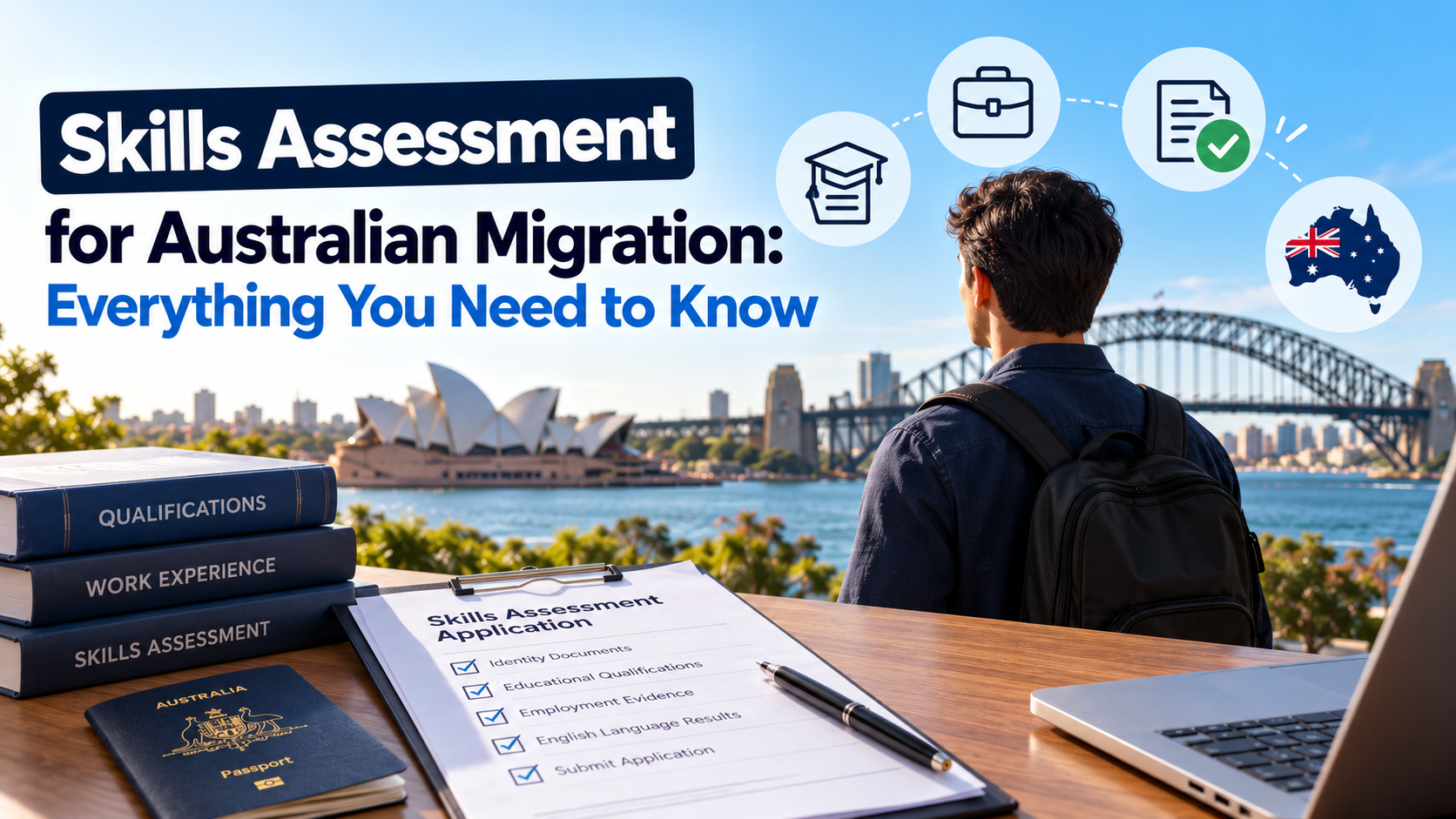
Australia continues to attract skilled professionals from around the world who are looking for better career opportunities, a high standard of living, and the possibility of obtaining permanent residency.
However, if you’re planning to migrate to Australia through a skilled visa pathway, one of the most important steps you may need to complete is a skills assessment.
A skills assessment is designed to determine whether your qualifications, employment experience, and professional skills meet the Australian standards for your nominated occupation.
For many skilled migration visa applicants, obtaining a positive skills assessment is an essential requirement before they can progress with their visa application.
But how does the process work? Which assessing authority should you apply to? How much does it cost, and what happens if your assessment is unsuccessful?
In this guide, we’ll explain everything you need to know about skills assessments for Australian migration, including eligibility requirements, assessing authorities, documentation, processing times, and common mistakes to avoid.
1. What Is a Skills Assessment for Australian Migration?
A skills assessment is a formal evaluation conducted by an authorised assessing authority to determine whether an applicant’s qualifications and professional experience meet the standards required for a particular occupation in Australia.
The assessment is generally based on your nominated occupation, educational qualifications, employment history, and any additional requirements established by the relevant assessing authority.
For example, if you’re applying for skilled migration as an accountant, engineer, IT professional, or tradesperson, you may need to have your qualifications and experience assessed by an organisation responsible for your occupation.
The purpose of a skills assessment is to ensure that applicants possess the necessary skills and qualifications to perform their nominated occupation in Australia.
It’s important to understand that a positive skills assessment does not automatically guarantee that you’ll receive an Australian visa.
You must still satisfy all other eligibility requirements for your chosen visa subclass, including any applicable age, English language, points, health, and character requirements.
2. Why Is a Skills Assessment Important?
Skills assessments play a significant role in Australia’s skilled migration system.
The Australian Government uses skills assessments to help verify that applicants have the professional qualifications and competencies required for occupations included in relevant skilled occupation lists.
For applicants pursuing points-tested skilled migration, a positive skills assessment is generally necessary before receiving an invitation to apply for a visa.
Skills assessments can also be relevant to certain employer-sponsored migration pathways, depending on the occupation, visa subclass, and individual circumstances.
Without a suitable skills assessment where one is required, applicants may be unable to proceed with their intended migration pathway.
Additionally, the outcome of a skills assessment can affect how your qualifications and employment experience are recognised for migration purposes.
This makes it essential to understand the requirements of your assessing authority before beginning the process.
3. Which Australian Visas Require a Skills Assessment?
Several Australian skilled migration pathways require applicants to obtain a suitable skills assessment.
The most common include:
Skilled Independent Visa (Subclass 189)
The Skilled Independent Visa allows eligible skilled professionals to obtain permanent residency without requiring employer or state sponsorship.
Applicants under the points-tested stream generally need a suitable skills assessment for their nominated occupation.
Skilled Nominated Visa (Subclass 190)
The Skilled Nominated Visa provides permanent residency to eligible skilled workers nominated by an Australian state or territory government.
Applicants must generally obtain a positive skills assessment for their nominated occupation and meet the relevant state nomination requirements.
Skilled Work Regional (Provisional) Visa (Subclass 491)
The Subclass 491 visa allows eligible skilled migrants to live, work, and study in designated regional areas of Australia.
Applicants generally need a suitable skills assessment and must receive either state or territory nomination or eligible family sponsorship.
Employer-Sponsored Visas
Skills assessments may also be required for certain employer-sponsored visas, including some applications under the Skills in Demand Visa (Subclass 482) and Employer Nomination Scheme Visa (Subclass 186).
However, the requirements vary depending on the visa stream, occupation, and applicant’s circumstances.
Not every employer-sponsored visa applicant is required to complete a separate skills assessment.
4. Who Conducts Skills Assessments in Australia?
Skills assessments are conducted by organisations authorised to assess particular occupations.
Each assessing authority has its own requirements, application procedures, fees, and processing times.
Some of the most commonly used assessing authorities include:
Some of the most commonly used assessing authorities include:
| Assessing authority | Common occupation areas |
|---|---|
| VETASSESS | Business, management, marketing, hospitality and other professional occupations |
| Australian Computer Society (ACS) | Information technology and computing |
| Engineers Australia | Engineering |
| Trades Recognition Australia (TRA) | Various trade occupations |
| Australian Nursing and Midwifery Accreditation Council (ANMAC) | Nursing and midwifery |
| CPA Australia, CA ANZ and IPA | Accounting |
| Australian Institute of Teaching and School Leadership (AITSL) | School teaching |
The appropriate assessing authority depends on your nominated occupation and the relevant visa requirements. Some occupations may have more than one recognised authority.
For example, an applicant seeking migration as a software engineer may need an assessment through the Australian Computer Society, while an applicant nominating a civil engineering occupation may need an assessment through Engineers Australia.
Choosing the correct assessing authority is essential because the Department of Home Affairs generally only accepts assessments issued by the authority specified for the relevant occupation and visa pathway.
5. What Documents Are Required for a Skills Assessment?
The documents required for a skills assessment vary depending on your occupation, assessing authority, qualifications, and employment history.
However, applicants are commonly asked to provide evidence of their identity, education, and professional experience.
Identity Documents
You may need to provide a copy of your passport, identification documents, and evidence of any name changes.
Educational Qualifications
Assessing authorities may request degree certificates, diplomas, academic transcripts, and other relevant qualifications.
Applicants who completed their education overseas may need to provide additional information about their educational institution or course content.
Employment Evidence
For occupations where work experience is assessed, applicants may need to submit employment reference letters, contracts, payslips, tax records, or bank statements.
Employment reference letters should accurately describe your position, responsibilities, employment dates, and working hours.
English Language Results
Some assessing authorities require applicants to demonstrate a particular level of English proficiency.
The requirements vary between occupations and authorities, and some assessments may not require an English language test.
Additional Professional Documents
Depending on your occupation, you may also need to provide professional registration, licences, portfolios, or evidence of practical training.
It’s important to ensure that all documents are genuine, accurate, and consistent with your application. Incomplete or incorrect documentation can lead to requests for additional information and longer processing times.
6. How to Apply for a Skills Assessment in Australia
Although the application process varies between assessing authorities, most applicants follow a similar process.
Step 1: Identify Your Nominated Occupation
Start by determining which occupation best matches your qualifications and professional experience.
Australian migration occupations are generally identified using occupation classifications and codes. It’s important to select an occupation that accurately reflects your skills and employment duties rather than simply choosing one with a similar job title.
Step 2: Find the Relevant Assessing Authority
Once you’ve identified your nominated occupation, determine which assessing authority is responsible for evaluating it.
Review the authority’s eligibility criteria, document requirements, and application procedures.
Step 3: Prepare Your Supporting Documents
Gather your educational qualifications, employment records, identification documents, and any additional evidence required.
Ensure that documents are translated into English where necessary and meet the authority’s submission standards.
Step 4: Submit Your Application
Most assessing authorities allow applicants to submit their applications online.
You will generally need to complete an application form, upload supporting documents, and pay the relevant assessment fee.
Step 5: Wait for Your Assessment Outcome
The assessing authority will review your qualifications and experience against the requirements for your nominated occupation.
Some applicants may be asked to provide additional documents, complete an interview, or undertake a practical assessment.
Step 6: Receive Your Skills Assessment Result
If your assessment is successful, you’ll receive a positive skills assessment outcome.
Depending on your intended visa pathway, you may then be able to use this assessment to support your Expression of Interest, state nomination application, or visa application.
7. How Long Does a Skills Assessment Take?
Skills assessment processing times vary significantly depending on the assessing authority, nominated occupation, and complexity of your application.
Some applications may be processed within a few weeks, while others can take several months.
For example, VETASSESS currently indicates an approximate processing time of seven weeks for standard professional occupation assessments, although complex applications or those requiring additional documentation may take longer.
Certain assessing authorities also offer priority processing services for eligible applicants.
It’s important to remember that these processing times are estimates and may change.
Applicants should consider beginning their skills assessment well before they intend to submit an Expression of Interest or lodge a visa application.
8. How Much Does a Skills Assessment Cost?
The cost of a skills assessment depends on the assessing authority, occupation, and type of assessment required.
Some authorities charge a standard application fee, while others may have additional charges for practical assessments, qualification verification, priority processing, or reviews.
For example, a standard VETASSESS full professional skills assessment currently costs approximately AUD $1,146 for applicants who are not Australian residents for tax purposes, or AUD $1,260.60 for applicants who are Australian residents for tax purposes.
Additional fees may apply for priority processing and other services.
These fees are separate from visa application charges, English language tests, medical examinations, and other migration-related expenses.
Before applying, check the latest fee schedule published by your assessing authority to understand the total cost involved.
9. How Long Is a Skills Assessment Valid?
A positive skills assessment does not necessarily remain valid indefinitely.
For Australian points-tested skilled migration, a skills assessment is generally accepted for up to three years from its issue date, unless the assessing authority specifies a shorter validity period.
For example, if your skills assessment was issued on 1 January 2026 and no shorter validity period applies, it would generally remain valid for migration purposes until 1 January 2029.
However, the applicable validity rules depend on your visa subclass and circumstances.
Applicants should ensure that their skills assessment meets the relevant validity requirements when they receive an invitation or lodge their visa application.
An expired assessment may need to be renewed or replaced before you can proceed.
10. What Happens If Your Skills Assessment Is Unsuccessful?
Receiving a negative skills assessment can be disappointing, particularly if you’ve spent considerable time preparing your application.
However, an unsuccessful assessment doesn’t necessarily mean that your Australian migration journey has come to an end.
The options available depend on the assessing authority and the reasons for the negative outcome.
For example, an application may be unsuccessful because the applicant’s qualifications don’t meet the required standards, their employment duties don’t align with the nominated occupation, or they haven’t provided sufficient supporting evidence.
Some assessing authorities allow applicants to request a review or reassessment.
In other circumstances, applicants may need to obtain additional qualifications, gain further relevant employment experience, or consider whether another occupation more accurately reflects their professional background.
How to avoid an unsuccessful assessment: Carefully review the eligibility requirements before applying and ensure that your nominated occupation genuinely matches your qualifications and employment experience.
11. Common Mistakes to Avoid When Applying for a Skills Assessment
Preparing a skills assessment application requires careful attention to detail.
Some of the most common mistakes include:
- Choosing the wrong occupation: Selecting an occupation that doesn’t accurately reflect your qualifications or employment duties.
- Submitting insufficient employment evidence: Failing to provide appropriate documents supporting your claimed professional experience.
- Applying through the wrong assessing authority: Using an organisation that isn’t authorised to assess your nominated occupation for your intended visa pathway.
- Providing inconsistent information: Submitting employment dates, job descriptions, or qualifications that don’t match your supporting documents.
- Applying too late: Underestimating assessment processing times and potentially missing migration opportunities.
- Using an unsuitable assessment: Assuming that a provisional assessment obtained for a temporary graduate visa will automatically satisfy permanent skilled migration requirements.
Taking the time to prepare a complete and accurate application can help reduce the likelihood of unnecessary complications.
12. Can International Students Apply for a Skills Assessment?
Yes. International students who have completed relevant qualifications in Australia may be eligible to apply for a skills assessment.
However, eligibility depends on their nominated occupation, qualifications, assessing authority, and intended visa pathway.
For example, some graduates may be able to apply for a skills assessment after completing an eligible Australian qualification.
Others may need to complete additional professional training, obtain relevant employment experience, or satisfy specific registration requirements.
It’s also important to understand that a skills assessment obtained for a Temporary Graduate Visa (Subclass 485) may not necessarily satisfy the requirements for permanent skilled migration.
For international students planning to pursue Australian PR, understanding the skills assessment requirements early can help them make informed decisions about their education and career pathways.
13. Does a Positive Skills Assessment Guarantee Australian PR?
No. Receiving a positive skills assessment is an important milestone, but it does not guarantee Australian Permanent Residency.
For points-tested skilled migration pathways, applicants must still satisfy several additional requirements.
These may include achieving the required migration points, meeting English language requirements, receiving an invitation to apply, obtaining state or territory nomination where required, and satisfying health and character criteria.
For example, an applicant may receive a positive skills assessment and achieve the minimum 65 migration points but still not receive an invitation to apply for a Subclass 189 visa.
This is because invitations depend on factors such as occupation demand, points scores, and migration program priorities.
A skills assessment should therefore be viewed as one important component of the overall migration process rather than a guarantee of visa approval.
Frequently Asked Questions About Skills Assessments in Australia
Can I Apply for a Skills Assessment Without Work Experience?
In some circumstances, yes. Certain occupations and assessing authorities may allow applicants to qualify based primarily on their educational qualifications. However, other occupations require relevant professional experience, practical training, or registration.
Can I Apply for a Skills Assessment From Outside Australia?
Yes. Many assessing authorities accept applications from overseas applicants. You don’t necessarily need to be living in Australia to complete a skills assessment.
Do I Need IELTS or PTE for a Skills Assessment?
Not always. English language requirements vary depending on the assessing authority and occupation. Some authorities require English language test results, while others do not. Separate English language requirements may apply to your visa application.
Can I Use My Overseas Qualifications for an Australian Skills Assessment?
Yes. Many assessing authorities assess qualifications obtained outside Australia. However, your qualifications must meet the relevant standards, and additional evidence or verification may be required.
Can I Apply for More Than One Skills Assessment?
In some circumstances, applicants may be able to obtain assessments for more than one occupation, provided they meet the requirements of the relevant assessing authorities. However, each assessment generally involves a separate application and associated fees.
Do I Need a Skills Assessment for a 482 Visa?
Not every applicant needs one. Mandatory skills assessments apply to certain Skills in Demand Visa (Subclass 482) applicants, depending on their occupation and circumstances. Some applicants may qualify for exemptions.
Can I Apply for Australian PR Immediately After Receiving a Positive Skills Assessment?
Not necessarily. A positive skills assessment is only one of the requirements for many skilled migration pathways. You may still need to submit an Expression of Interest, obtain state nomination, receive an invitation, and meet other visa eligibility criteria.
How KBA Global Can Help With Your Skills Assessment and Australian Migration
Understanding Australia’s skills assessment requirements can be challenging, particularly when different occupations have different assessing authorities, qualification standards, and employment experience requirements.
At KBA Global, our experienced migration professionals can help you understand the skills assessment process and how it fits into your overall Australian migration journey.
Whether you’re an international student preparing for skilled migration, an overseas professional exploring Australian employment opportunities, or a temporary visa holder planning to apply for permanent residency, our team can help you assess your available options.
We can assist you in understanding your nominated occupation, identifying the relevant assessing authority, reviewing the documentation requirements, and exploring suitable migration pathways based on your circumstances.
Planning to apply for an Australian skills assessment?
Contact KBA Global today to book a migration consultation and take the next step towards achieving your Australian migration goals.
Disclaimer: This article provides general information only and does not constitute migration or legal advice. Skills assessment requirements, fees, processing times, and Australian visa eligibility criteria may change. Applicants should confirm the latest requirements with the relevant assessing authority and the Department of Home Affairs or consult a registered migration agent for advice specific to their circumstances.